

The mistake most teams make
The default framing for a chatbot is 'answer FAQs.' That's a support tool, not a growth tool. It saves headcount at best and annoys visitors at worst.
The reframing that unlocks value: treat the bot as your best sales development rep. It qualifies, personalises the pitch, and hands off to a human — or a Calendly — the moment intent is clear.
A support bot deflects. A sales bot advances. Every prompt, every retrieval, every response should push the conversation one step closer to a booked meeting or a completed purchase. If a message doesn't do that, cut it.
The four-turn playbook
Turn one: ask what problem they're trying to solve, not who they are. Turn two: mirror the problem back with one clarifying question. Turn three: name the two most relevant proof points from your case studies. Turn four: propose the next step — a call, a demo, a trial — with a single visible CTA.
Four turns is the ceiling before drop-off spikes. If you can't get to a next step in four, the flow is wrong.
The magic isn't in the model. It's in the discipline. Most 'chatbot' projects fail because they let the model roam. The best ones constrain it — a tight system prompt, a small retrieval set, a fixed path to a CTA. Boring. Effective.
What we measure
Qualified conversation rate, meeting-booked rate, and cost per meeting. When these three tie back to CRM, the bot stops being a widget and starts being a revenue channel.
Cost per meeting is the number that changes minds. When leadership sees a bot booking meetings at 30% of the cost of a human SDR — with 24/7 coverage across time zones — the conversation stops being about 'do we need AI' and starts being about how fast to scale it.
How we validate this in real client work
At Rankzio, we treat every automation recommendation as a hypothesis until the market proves it. Before a client commits budget, we review analytics, search behaviour, conversion paths, CRM notes, creative history and sales objections. That evidence tells us whether the problem is demand, trust, speed, message-market fit, distribution or measurement. The distinction matters. A brand with a tracking problem does not need more content yet; a brand with weak authority does not need another landing-page redesign first. The correct sequence is what protects budget and builds trust.
The senior review is practical rather than ceremonial. A strategist checks the business logic, a specialist checks the channel assumptions, and an editor checks whether the argument is clear enough for a busy founder to act on. If the idea cannot survive those three reviews, it does not become a client recommendation. This is the EEAT standard we use internally: experience from real campaigns, expertise from people who operate the channels, authority from documented evidence, and trust from explaining the trade-offs without hiding behind jargon.
What teams should do next
Start with a focused audit instead of a broad brainstorm. Pick one page, one funnel, one campaign, or one content cluster and ask three questions: what is the buyer trying to decide, what proof are we giving them, and where does the measurement become unreliable? Most growth problems become easier once those answers are visible. The next step is usually not a bigger plan; it is a cleaner signal. Clean signal lets you choose the next experiment with confidence.
Then build a 30-day operating rhythm. Assign one owner, define one success metric, document every change, and review progress weekly. The brands that win are rarely the ones with the most complicated dashboards. They are the ones that make fewer, better decisions and repeat them consistently. Whether you are applying this article to SEO, ads, content, social or automation, the principle is the same: make the work measurable, make the owner clear, and make the learning visible enough that the next decision gets easier.

Common mistakes to avoid
The first mistake is copying a tactic without copying the context that made it work. A competitor's content cadence, ad format, chatbot flow or website structure may look attractive, but their audience, price point, proof, brand awareness and sales cycle may be completely different. Borrow the principle, not the surface pattern. In our audits, the expensive failures usually come from teams imitating the visible output while ignoring the invisible operating system underneath it.
The second mistake is judging too early. Many worthwhile systems need enough impressions, crawls, conversations or conversions before the signal is useful. That does not mean waiting blindly. It means setting a fair test window, agreeing on leading indicators, and changing direction only when the evidence is strong. Good growth work is decisive, but it is not impulsive. The goal is to learn faster than competitors without letting noise masquerade as insight.
Which model should I use?+
GPT-4o or Claude Sonnet for conversation, plus a small embedding model for retrieval over your knowledge base. Route via Lovable AI Gateway so you can swap without rewriting.
How much does a sales bot cost to run?+
For most services businesses, under ₹15,000/month in inference costs — dwarfed by the pipeline it generates. The bigger cost is the build, not the running.
Will it hallucinate?+
Not if you use retrieval + strict system prompts + a small eval suite. We run 200+ scripted evals nightly for every bot we ship.
Can I integrate with WhatsApp?+
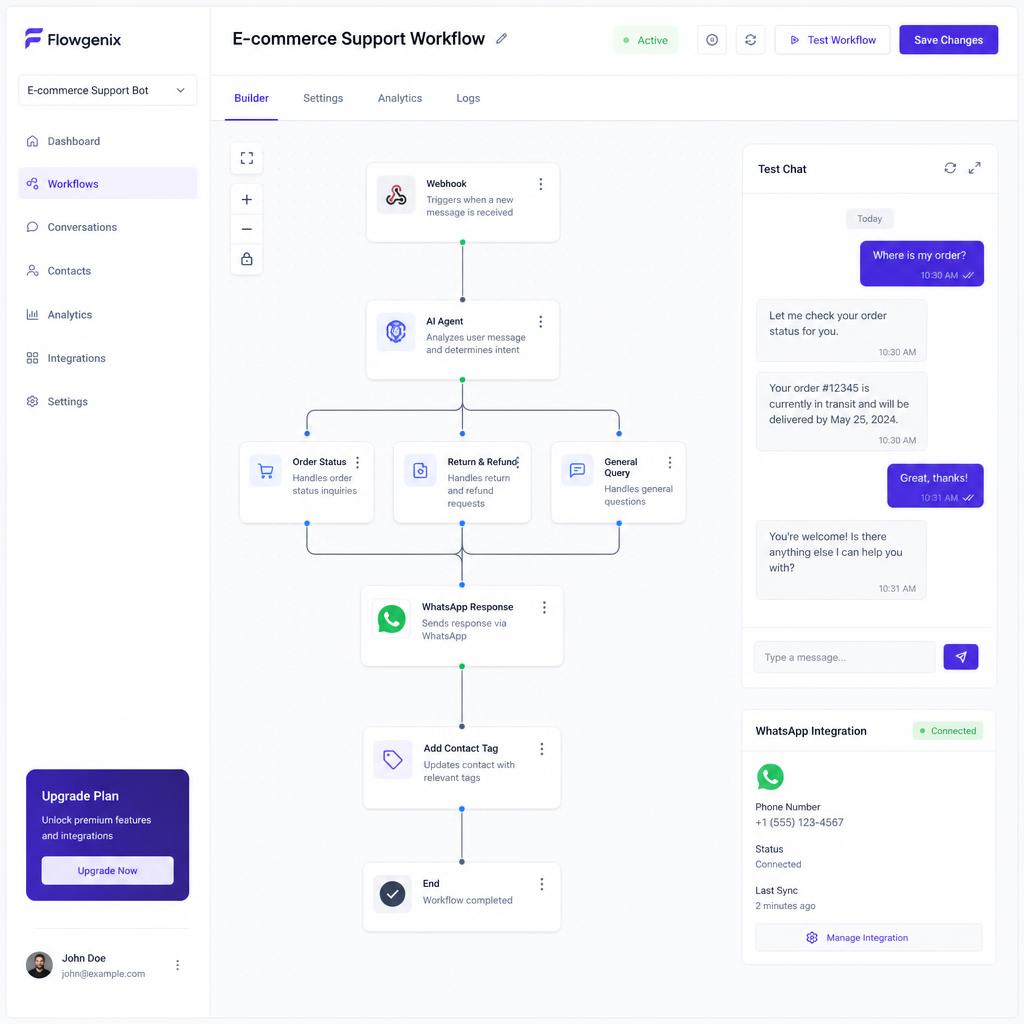
Yes. WhatsApp Business API + a lightweight orchestration layer (n8n or a custom Node service) is the setup we now ship by default.
Turn the insight into a growth system.
Rankzio can audit your current setup and map the fastest path from this playbook to measurable revenue.
Book a strategy call